We take your security very seriously. In order to protect you and our systems, we are making changes to all HSBC websites that means some of the oldest web browser versions will no longer be able to access these sites. Generally, the latest versions of a browser (like Edge, Chrome, Safari, etc.) and an operating system family (like Microsoft Windows, MacOS) have the most up-to-date security features.
If you are seeing this message, we have detected that you are using an older, unsupported browser.
The "Mid Se More Tak" campaign for HSBC Mutual Fund shows that mid-cap companies aren't risky startups. They are already successful, established businesses ready to take their next big leap. Based on the idea that today’s industry giants all started as growing mid-sized brands, the campaign uses "The Snack Factory" film to bring this growth story to life. When a proud father celebrates dominating the state market, his calm, forward-thinking son casually points out their next goal: taking over the whole country. By showing a real business scaling up from state-wide success to national expansion, the campaign simply and clearly explains the true value of Mid cap: they give investors a chance to spot tomorrow's market leaders and join their journey today.
Success!
Your information was saved successfully!
Your information was saved successfully! Our customer service will contact you within 24-48 hours to get you full onboard.
As per SEBI’s market-capitalisation classification, mid-cap companies are ranked 101st to 250th in terms of full market capitalisation.
Based on AMFI’s January–June 2026 classification, the average full market capitalisation at the category boundaries was approximately Rs 33,664 crore to Rs 1,06,278 crore.
Mid-cap mutual funds are required to invest at least 65 per cent of their total assets in equity and equity-related instruments of mid-cap companies, subject to applicable regulatory requirements.
Why Consider Mid Cap Funds?
Emerging Businesses with Growth Potential
A Blend of Business Maturity and Growth Opportunities
Opportunities Across Sectors
Research-led Stock Selection Opportunities
Potential to Become Tomorrow’s Large-cap Companies
Mid cap stocks represent companies that fall within the mid cap segment of the equity market. They typically sit between large-cap and small-cap companies in terms of market capitalisation.
The primary difference is the size of the companies they predominantly invest in, based on market capitalisation. Large-cap funds focus on the largest companies, while mid cap funds invest predominantly in mid-cap companies and small-cap funds in small-cap companies. Each segment can have a different risk-return profile and may behave differently across market cycles.
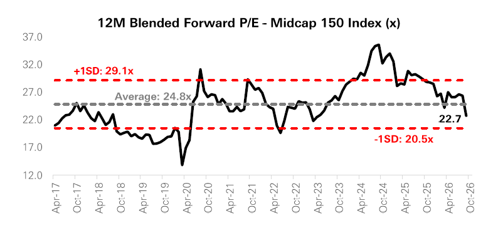
Valuations play a key role in mid cap investing. As of September 2026, the Midcap 150 Index was trading at a 12-month blended forward P/E of 22.7x, below its long-term average of 24.8x. This follows a correction of over 35 per cent in valuation multiples from the September 2024 peak, making valuations more reasonable.
Source: Bloomberg, HSBC Mutual Fund, Data as on 31 Oct 2026
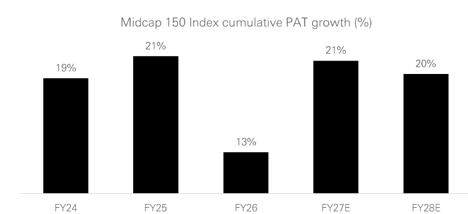
The earnings outlook remains encouraging, with Midcap 150 Index profit after tax (PAT) growth projected at 21 per cent in FY27E, following 13 per cent growth in FY26. Growth is expected to remain strong at 20 per cent in FY28E, reflecting a positive earnings outlook.
Source: Bloomberg, HSBC Mutual Fund, Data as on 31 Oct 2026
Mid cap valuations appear more reasonable following the recent correction. With the Midcap 150 Index trading at 22.7x forward P/E, against its long-term average of 24.8x, and PAT growth projected at 21 per cent in FY27E, valuations look attractive even on a price-to-earnings-to-growth (PEG) basis. However, mid cap investments remain subject to market volatility.
Mid cap companies can be at a stage where they have established businesses but may still have significant room for expansion. Mid cap funds can therefore provide investors with an opportunity to participate in the potential growth of such companies through a diversified portfolio.
Mid cap funds are subject to equity-market risks and can experience periods of higher volatility. Their performance can be influenced by economic conditions, company earnings, valuations, liquidity and market sentiment. Investors should therefore consider their risk appetite and investment horizon before investing.
Mid cap funds are generally considered more appropriate for investors with a long-term investment horizon. Staying invested through different market cycles can give the underlying companies time to execute their growth plans and potentially realise their business potential.
Yes. Investors can invest in a mid cap mutual fund through a Systematic Investment Plan (SIP). SIP allows investors to invest a predetermined amount at regular intervals.
Under an SIP, a fixed amount is invested at regular intervals. Depending on the market price, the same investment amount purchases different numbers of units at different points in time. This enables investors to invest systematically across market conditions. However, SIPs do not assure returns or protect against losses.
Mid cap funds can experience fluctuations during periods of market volatility, and their prices may move significantly in either direction. A long-term investment approach can help investors remain focused on the underlying fundamentals rather than short-term market movements.
Factors such as revenue and earnings growth, business fundamentals, management quality, competitive position, valuations, economic conditions, interest rates and sector-specific developments can influence the performance of mid cap companies.
SEBI Registered Name/Number-HSBC Mutual Fund & MF/046/02/5
Note: The sector(s)/stock(s)/issuer(s) mentioned in this document do not constitute any research report nor it should be considered as an investment research, investment recommendation or advice to any reader of this content to buy or sell any stocks / investments. The Fund/portfolio may or may not have any existing / future position in these sector(s)/stock(s)/issuer(s). Past performance may or may not be sustained in future and is not a guarantee of any future returns.
An Investor Education & Awareness Initiative by HSBC Mutual Fund
This document is intended only for distribution in Indian jurisdiction. Neither this document nor the units of HSBC Mutual Fund have been registered under Securities law/Regulations in any foreign jurisdiction. The distribution of this document in certain jurisdictions may be unlawful or restricted or totally prohibited and accordingly, persons who come into possession of this document are required to inform themselves about, and to observe, any such restrictions. If any person chooses to access this document from a jurisdiction other than India, then such person do so at his/her own risk and HSBC and its group companies will not be liable for any breach of local law or regulation that such person commits as a result of doing so.
Mutual Fund investments are subject to market risks, read all scheme related documents carefully.
The value of investments and any income from them can go down as well as up and investors may not get back the amount originally invested.
Beginning of dialog window. It begins with a heading called "You are leaving the HSBC AMG website.". Escape will cancel and close the window.
You are leaving the HSBC Asset Management website.
Please be aware that the external site policies will differ from our website terms and conditions and privacy policy. The next site will open in a new browser window or tab.
Beginning of dialog window. It begins with a heading called "Terms and Conditions". Escape will cancel and close the window.
Terms and conditions
This Site is intended for Mutual Funds in India only.
You must read carefully the terms and conditions and disclaimers set out here (the 'Terms') and agree to be bound by these Terms prior to registering as a user of this website (the 'Site'). By selecting ACCEPT you agree to be bound by these Terms. If you do not agree to be bound by these Terms please select the DECLINE option below.
By continuing to browse this site, you give consent for use of cookies to give you the best possible experience on our website. Read our Cookie Policy